Here's What 15 Years of Coaching Taught Me
Do You Really Need a Perfect Morning Routine?

Here's the uncomfortable truth: Most successful entrepreneurs I've worked with don't have "perfect" morning routines.
They have consistent ones.
After coaching hundreds of business owners over the past 15 years, I've watched people torture themselves trying to create the Instagram-worthy morning routine they saw on LinkedIn. Meanwhile, the ones actually building million-pound businesses? They're doing something completely different.
Let me save you years of frustration and show you what actually works.
The Perfection Trap That's Killing Your Progress
I've seen it countless times. A driven entrepreneur reads about some tech CEO's 5am meditation-cold shower-journaling-workout routine and thinks, "Right, that's what I need to succeed."
Three weeks later, they've given up entirely.
Here's what the research actually shows: structured mornings reduce stress hormones by up to 50% compared to chaotic wake-ups. But notice what it doesn't say: it doesn't mention anything about perfection.
The magic happens through consistency, not complexity.
Think about it logically. If your morning routine requires you to be perfect every single day, what happens when life inevitably gets in the way? You miss one day, feel like a failure, and abandon the whole thing.
Sound familiar?
What 15 Years of Real-World Coaching Actually Taught Me
Here's the data that matters: The behaviour typically takes about 66 days to become automatic. But here's the kicker: that range goes from 18 to 254 days depending on complexity.
Translation? The more complicated you make it, the longer it takes to stick.
The most successful clients I've worked with follow what I call the "30-Minute Rule." Research shows most people naturally gravitate toward about 30 minutes of morning activities. That's your sweet spot.
Not 2 hours. Not 30 seconds. About 30 minutes.
In that time, you're not trying to transform your entire life. You're doing three things:
- Waking your brain up properly
- Setting intention for the day
- Creating momentum
That's it.
The Habits That Actually Move the Needle
Forget the exotic routines you see on social media. The most commonly practised morning habits are refreshingly simple:
• Brushing teeth (65% of people)
• Drinking water (60%)
• Making coffee (51%)
Notice what's not on that list? Ice baths, 45-minute meditation sessions, or writing in a gratitude journal while standing on one leg.
The fundamentals work because they're sustainable.
Here's what I've learned actually matters: exposure to morning light, moderate movement, hydration, and eating something. These aren't revolutionary concepts: they're basic human needs wrapped in a consistent package.
The science backs this up. Your brain thrives on predictability, not perfection. When you do the same basic things in roughly the same order, you're giving your nervous system what it needs to function optimally.
The Simple Framework That Works
After years of testing different approaches with clients, I've distilled this down to what I call the Power-Up Protocol:
Step 1: Visualisation of the day ahead (5 minutes)
I do this whilst still in bed. A visualisation of the day ahead if the best outcomes happen.
Step 2: Prime yourself (10 minutes)
This for me is freshly ground coffee and my supplements, including a pint of water.
Step 3: Review your golas (15 minutes)
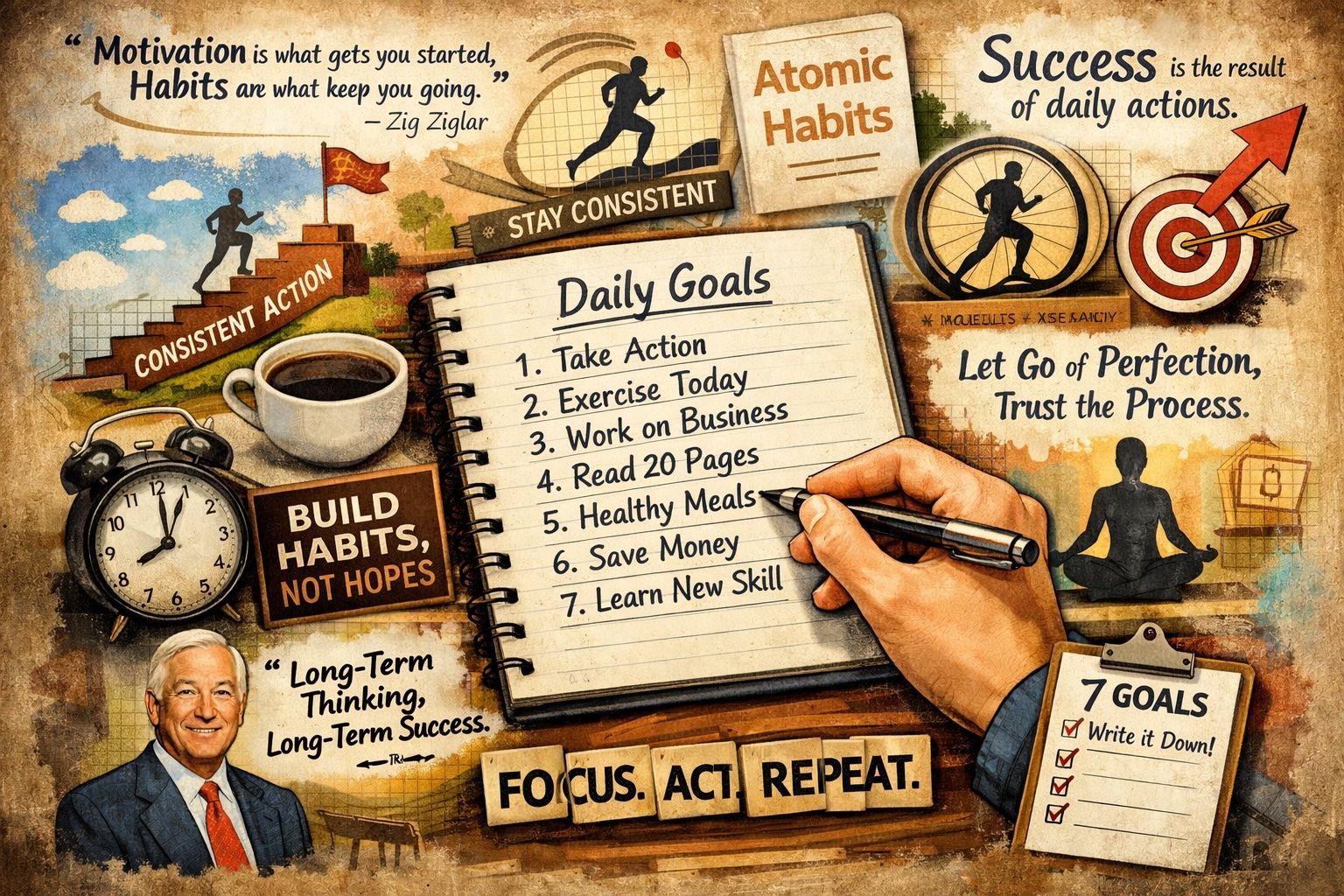
My seven-step goal process is aimed at giving you a balanced overview of what you want to achieve. Then decide what from that list you will do today to get closer to each goal.
The key? These aren't rigid requirements. They're flexible guidelines that adapt to your life, not the other way around.
Why Starting Small Crushes Starting Perfect
Here's a coaching secret: I never start clients with their "ideal" routine. Ever.
I start them with something so simple they'd be embarrassed not to do it.
Want to start exercising in the morning? We begin with a walk or maybe some press-ups straight after cleaning their teeth. We call this habit stacking a powerful tool.
Want to begin writing goals? We start with buying a journal notepad and putting it somewhere you will see in the morning.
This isn't because I think you're incapable of more. It's because your brain needs to trust the new habit before it invests energy in it.
The "After [current habit], I will [new habit]" method works because you're anchoring new behaviours to things you already do automatically. After I brush my teeth, I'll exercise. After I make coffee, I'll write down my goals.
Simple. Stackable. Sustainable.
The Real Question You Should Be Asking
Instead of "What's the perfect morning routine?" ask yourself this: "What's the simplest thing I can do consistently that will give me momentum for the day?"
Because here's what the data shows: 37% of people can tell within 10 minutes of waking whether their day will be good or bad.
That's not about having the perfect routine. That's about having any routine that helps you start with intention rather than reaction.
The entrepreneurs who succeed long-term aren't the ones with the most sophisticated systems. They're the ones who show up consistently, even when they don't feel like it.
Especially when they don't feel like it.
Your Next Move
Stop trying to build the perfect morning routine. Start building a consistent one.
Pick three simple things you can do in 30 minutes or less. Do them for 66 days. Then: and only then: consider adding complexity.
Your future self will thank you for choosing consistency over perfection every single time.
If you're serious about building the kind of consistency that actually drives business results, I've created a framework that takes the guesswork out of goal-setting and habit formation. It's called the 7 Goals System, and you can download the poster here to see how successful entrepreneurs structure their priorities.
Because at the end of the day, success isn't about having the perfect routine.
It's about having a routine you can perfect through repetition.
To your success,
Grant