5 Mistakes Most Founders Make - Let's Play Grant Stain Bingo

Grant Stain • January 18, 2026

Are You Making These 5 Fatal Startup Mistakes? What 15 Years Coaching 300+ Companies Taught Me

After 15 years of coaching over 300 companies, I've developed what my clients affectionately call "Grant Stain Bingo."


It's not a game I invented on purpose. It's a collection of phrases I find myself repeating so often that entrepreneurs started ticking them off like squares on a bingo card.


Why do I repeat them? Because the same fatal mistakes keep showing up. Different businesses, different industries, different founders: same bloody problems.


The frustrating part? These aren't complex issues requiring an MBA to solve. They're foundational errors that get overlooked because everyone's too busy chasing the "sexy" stuff: the marketing hacks, the viral strategies, the growth shortcuts.


Here's the truth: your startup won't fail because you didn't find the perfect Instagram filter. It'll fail because you ignored the basics.


Let me walk you through the five mistakes I see destroying startups week after week: and the bingo phrases that'll help you remember how to fix them.


---


Mistake 1: Your Goals Are Wishy-Washy Nonsense


"I want to grow my business."


"I'd like to make more money this year."


"I want to be successful."


Brilliant. And I want to be taller. Neither of us has a plan.


Here's my first bingo phrase: Measure everything.


If you can't put a number on it, it's not a goal: it's a daydream. When entrepreneurs tell me they want to "grow," I ask them one simple question: by how much, by when?


The silence that follows tells me everything.


Proper goal setting means getting ruthlessly specific:


- "Wrong" - "I want more clients"

- "Right" - "I will acquire 15 new clients by March 31st, generating £45,000 in revenue"


- "Wrong" - "I need to improve my marketing"

- "Right" - "I will increase website enquiries from 20 to 50 per month within 90 days"


When you measure everything, you create accountability. You know exactly where you stand. You can course-correct before it's too late.


I've built an entire "7 Goals System" (https://www.grantstain.com/goal-setting-that-actually-works) around this principle because vague goals lead to vague results. And vague results lead to closed businesses.


Your action step: Take your top three business goals right now. Add a specific number and a deadline to each one. If you can't, they're not goals: they're wishes.


---


Mistake 2: You Haven't Built Your Mental Armour


Starting a business is a contact sport. You're going to get hit: by rejection, by failure, by people who don't believe in you, by your own self-doubt at 3am.


Most founders prep their business plan but completely neglect their mental game.


My second bingo phrase: Mindset moves mountains.


I've watched technically brilliant entrepreneurs crumble at the first sign of adversity. I've also watched average founders with bulletproof mindsets push through obstacles that would stop most people dead.


The difference? Preparation.


Your mindset isn't some woo-woo concept. It's a skill you develop through deliberate practice:


- Morning routines that prime you for action, not anxiety

- Core values that guide decisions when everything feels chaotic

- Self-talk patterns that build you up instead of tear you down


The entrepreneurs who survive the startup gauntlet aren't the ones who avoid problems. They're the ones who've trained themselves to see problems as puzzles to solve rather than reasons to quit.


If you haven't defined your "core values" and built a personal operating system, you're heading into battle without armour. Good luck with that.


Your action step: Write down three things that consistently derail your focus or confidence. For each one, create a specific response strategy you'll use next time it happens.


---


Mistake 3: You Think This Will Be Easy


Here's where I'm going to sound like your grumpy uncle at Christmas dinner.


You're probably underestimating how hard this is going to be. Significantly.


My third bingo phrase: Work like a maniac.


The statistics are brutal. Around 20% of startups fail in year one. By year five, that number climbs to roughly 50%. I've written about why startups fail before, and the reasons often come down to underestimating the sheer graft required.


Social media has given everyone a warped perception of entrepreneurship. You see the highlight reels: the wins, the launches, the champagne moments. You don't see the 80-hour weeks, the missed family dinners, the moments of genuine terror about making payroll.


I'm not saying this to scare you off. I'm saying it so you're not blindsided when it gets tough.


Because here's what happens when you expect it to be easy: the first real challenge feels like a sign you should quit. "Maybe I'm not cut out for this," you think. "Maybe this isn't meant to be."


Rubbish. It's meant to be hard. That's what filters out the competition.


Your action step: Audit your current work ethic honestly. Are you putting in the hours your ambitions require? If there's a gap, close it. Starting tomorrow.


---


Mistake 4: You Hate the Boring Bits (And It Shows)


Every entrepreneur loves the creative stuff. The brainstorming. The big picture thinking. The exciting new ideas.


You know what nobody loves? Following up on quotes. Updating the CRM. Sending that fifth email to a prospect who's gone quiet.


My fourth bingo phrase: Repetition builds reputation.


The unglamorous, repetitive tasks are where businesses are actually built. The entrepreneur who sends 50 prospecting emails every single day will outperform the "visionary" who only works when they feel inspired.


Every. Single. Time.


Discipline isn't about motivation. Motivation is fickle: it shows up when it fancies and disappears when you need it most. Discipline is about systems.


Build processes for the boring stuff:

- Block time in your diary for repetitive tasks (and treat it as non-negotiable)

- Create checklists so you don't have to think about what needs doing

- Track your consistency: remember, measure everything


The founders who get bored of the basics don't build businesses. They build expensive hobbies.


Your action step: Identify the one repetitive task you've been avoiding. Schedule it into your calendar for the same time every day this week. No excuses, no rescheduling.


---


Mistake 5: Your Pipeline Is a Trickle


Finally, the mistake that kills more businesses than any other.


Not enough prospecting.


My fifth bingo phrase, and possibly the most important: Sales cures all.


Cash flow problems? More sales fix that. Team morale issues? More sales fix that. Can't afford better marketing? More sales fix that.


Yet I meet entrepreneurs every week who spend 90% of their time on everything except finding new customers. They're perfecting their website, tweaking their logo, fiddling with their website or faffing about on social media thinking you doing work.


Meanwhile, their pipeline is bone dry.


Here's a hard truth: if you're not uncomfortable with how much prospecting you're doing, you're not doing enough.


The maths is simple. If you need 10 clients and your conversion rate is 10%, you need 100 conversations. Not 100 LinkedIn connections: 100 actual conversations with potential buyers.


Are you having those conversations? Or are you hiding behind "busy work" that feels productive but doesn't move the needle?


Your action step:  Calculate how many sales conversations you need this month to hit your target. Divide by working days. That's your daily prospecting minimum. Non-negotiable.


---


The Foundation You're Missing


These five mistakes share a common thread: they're all foundational issues.


Goal setting. Mindset. Work ethic. Discipline. Sales activity.


None of them are glamorous. None of them will go viral on TikTok. But collectively, they form the entrepreneurial foundations that separate businesses that survive from businesses that become cautionary tales.


If you're reading this and recognising yourself in one or more of these mistakes, you're not alone. Every entrepreneur I've coached: every single one: has struggled with at least a couple of these.


The difference between success and failure isn't avoiding mistakes. It's recognising them quickly and having the discipline to correct course.


So here's your bingo card. Tick off the ones you're guilty of. Then do something about it.


Because knowing the problem without taking action is just procrastination with extra steps.


To your success,


Grant


By Grant Stain January 11, 2026
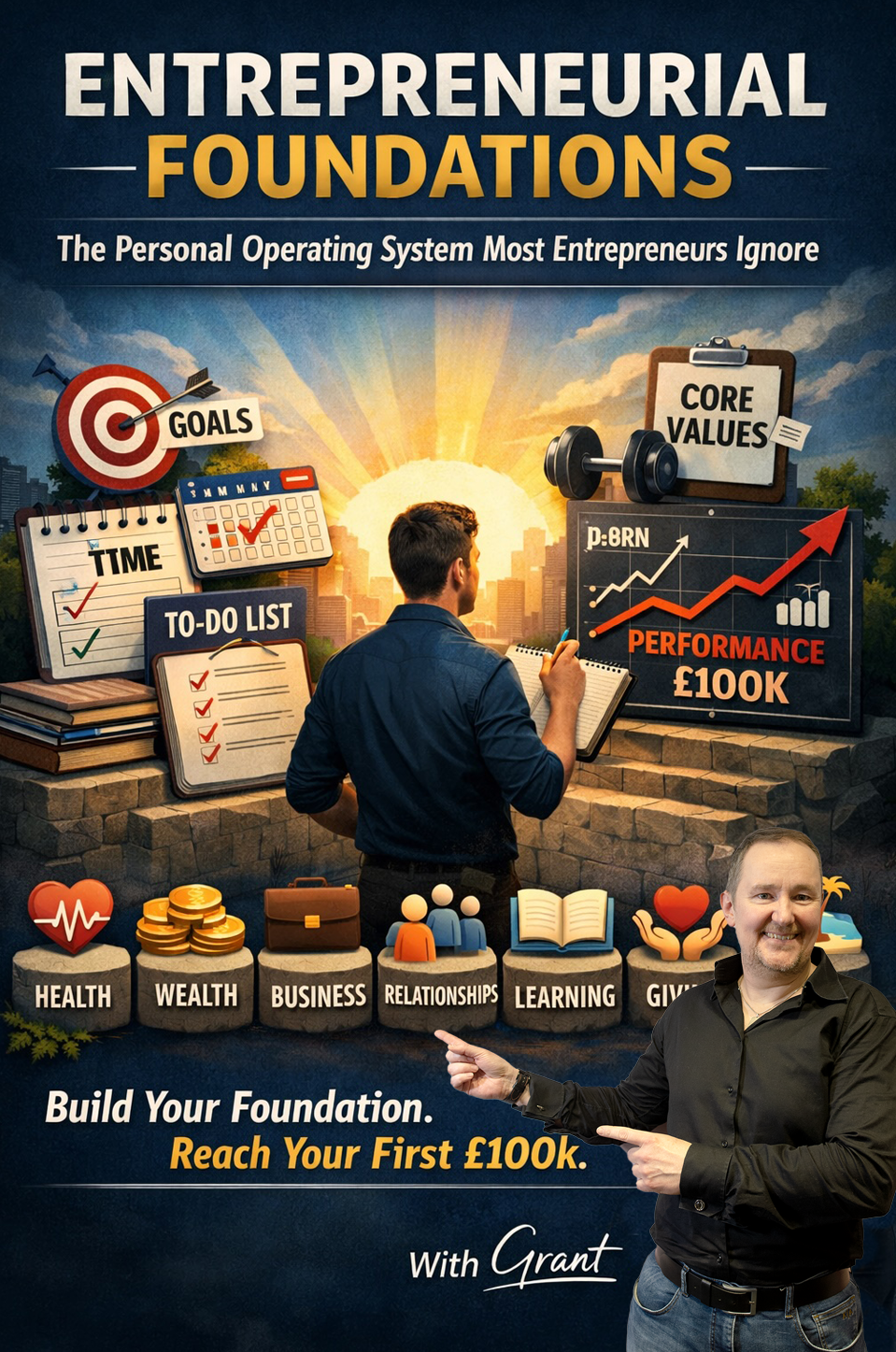
The Personal Operating System Most Entrepreneurs Ignore
By Grant Stain January 4, 2026
Every January, people don’t fail because they lack motivation...
Clipboard with
By Grant Stain December 28, 2025
Why Most People Get It Wrong, and How to Fix It
By Grant Stain December 15, 2025
Breaking Down the Real Numbers and Hard Truths
By Grant Stain November 30, 2025
Do You Really Need a Perfect Morning Routine?
By Grant Stain November 24, 2025
Most people think entrepreneurship is about the big ideas, the brand, the logo, the pitch. It is not. Those things are surface-level. The real work, the stuff that makes your business durable and worth something, happens underneath. It is the foundations. And if you get these right, everything else becomes easier, faster and more profitable. This is the part nobody glamorises, yet it is exactly what separates the people who build something meaningful from the people who stay stuck in project mode, earning bits here and there and wondering why nothing ever scales. So let us break down the fundamentals that give you stability, clarity and momentum. Diary management: control your time or your time controls you Successful entrepreneurs act like architects. They design their days with intention. They do not wake up and hope the day behaves. They decide what gets their focus and when. Your diary is not a list of tasks. It is the engine room of your entire business life. Block your strategy time. Block your prospecting. Block your client delivery. Block your learning. If it is not in the diary, it does not happen, and if it does not happen, it does not grow. The entrepreneurs who win are the ones who learn to protect their time with discipline. Core values: the guardrails that keep your business sane Values are not fluffy statements. They are decision making tools. When your business grows, when you take on clients, when you hire, when the pressure turns up, you need a set of rules that guide your behaviour and keep you aligned. Your values decide who you work with, how you show up, and what you refuse to tolerate. They stop you chasing the wrong clients and they keep your team rowing in the same direction. Get clear on your values and you instantly make your business easier to run. SOPs: the unsexy secret of scalable entrepreneurship Most small business owners run everything from their head. That is fine at the start, but it is a bottleneck once you have any traction. Standard Operating Procedures remove the chaos. They turn your daily work into a repeatable system. Every repeat task needs a process. Onboarding. Content creation. Lead follow up. Campaign setup. Reporting. Document it, refine it, then follow it. SOPs are how you scale without losing quality. They are how you stop firefighting. They are how you build a business that can run without you. Ignore them and you will stay trapped in the weeds forever. Goal setting: clarity creates momentum Most people drift. Entrepreneurs who succeed set targets and track them. You need clarity on what you want in ninety days, twelve months and three years. You do not need complicated frameworks. You need simple, measurable commitments that force progress. More clients. More recurring revenue. A better offer. A stronger brand. Whatever matters, write it down and make it visible. Momentum builds from clarity, not guesswork. Measurement: the truth behind your decisions If you are not measuring, you are guessing. Guessing is expensive. You need numbers to tell you what is working and what is not. Track your leads, conversions, revenue, retention and activity levels. Data gives you calm, confidence and control. It helps you make tough calls without emotion. It stops you wasting money. It shows you where to focus. Entrepreneurs who measure scale faster, because they can see the real story. Habits: the compound interest of entrepreneurship Your outcomes are the result of your habits, not your intentions. The small behaviours you repeat daily create your identity as an entrepreneur. Reading. Learning. Prospecting. Following up. Improving your offer. Turn these into habits and your growth becomes automatic. Habits build discipline and discipline builds freedom. Resilience: the essential tool nobody teaches You will get knocked about in business. That is guaranteed. The market does not care about your plans and your clients do not care about your excuses. Resilience is what keeps you moving when things take longer than expected. The good news is that resilience is built through action. Every time you face a challenge and push through it, you strengthen your foundation. You become sharper, calmer and more relentless. That is the real edge in entrepreneurship. Build your foundations and everything else becomes easier If you want to grow a digital agency or any small business, do not start with fancy tactics. Start with the basics. These are the pillars that support every high-performing entrepreneur. Your diary gives you control. Your values give you direction. Your SOPs give you scale. Your goals give you purpose. Your measurements give you truth. Your habits give you consistency. Your resilience gives you staying power. Get these foundations in place and you become unstoppable. Skip them and you stay busy without progress. Build properly and your business becomes a vehicle for freedom, not stress. The early work feels tedious, but it sets you up for the long haul. Master the fundamentals and everything you touch becomes easier, faster and more profitable. To your success, Grant
By Grant Stain November 16, 2025
Hitting £5k a month is the moment it all stops feeling like a hobby. It is the point where most digital agency owners finally breathe out and think, "this is working". You stop questioning whether you can call yourself an entrepreneur and you start acting like one. It is a serious milestone, and if you are building a service business based on recurring revenue, it is the first real sign that you have traction. The good news is that £5k a month is not some mythical target. It is simple maths. A handful of recurring clients paying you between £250 and £1,500 a month. Five clients at £1,000 each. Ten clients at £500 each. Even twenty clients at £250 each if you are on the lower end of the pricing scale. The mix does not matter. What matters is that you reach that level where the monthly revenue covers your costs, covers your life, and gives you breathing space. This is where the shift happens. You stop waking up worrying about whether you have enough work coming in. You stop second-guessing your value. Instead, you start thinking about systems, pricing, processes, team, scale. These are the thoughts of an entrepreneur, not a side gigger. I've seen some people within the Blam Digital Partnership hit £5k a month fast. They drop into the market with confidence, momentum, and a network, and within a few months they are already there. Others take longer. They make mistakes, tweak their offer, adjust their message, learn how to speak to business owners properly, and build belief along the way. Both journeys are valid. Both still end at the same point, a sustainable £5k a month. What makes this number important is not the money itself. It is the consistency. A run of monthly paying clients shows you are solving real problems and doing it well enough that people pay you again and again. That is the core of any successful digital agency. Predictability. Renewal. Retainers. Once you lock those in, you have a proper business model, not a series of random jobs. At £5k a month you finally feel in control. You can reinvest. You can outsource the work you should not be doing. You can improve your fulfilment. You can spend more time selling. You can upgrade your tools. You can raise your fees without blinking. All because you are now building from a place of strength, not scarcity. The beauty is that from here, the path to £10k a month feels achievable. You have proof that everything you are doing works. You know how to sell. You know who you want as clients. You know what problems you solve. You know how to deliver. You are no longer guessing. You are scaling. If you are not yet at this point, make it your first serious target. Get your recurring revenue up. Build trust with a small group of clients and deliver at a level that gives them zero reason to leave. Do the simple things well, talk to more people, make more offers, follow up relentlessly, and give every client a great experience. Your first £60k year is the bridge between wanting to be an entrepreneur and actually being one. Once you cross it, everything changes. You stop playing small. You stop apologising for your ambition. You stop wondering if this is ever going to work. Because you now have proof that it already is. To your success, Grant
By Grant Stain November 9, 2025
We live in a world where it’s easier than ever to set yourself up in business and call yourself a digital marketing consultant. You can build a website, attend a couple of networking events, post a couple of dubious case studies and suddenly you’re “open for business.” I see this all the time. Newbies, that have limited experience in digital marketing, throwing themselves into the deep end. Often, the first thing many new consultants learn is how to sell, which is fine, because sales drive everything, but not so good if there's no robust delivery system, onboarding process and capacity for more clients as well. So the real test comes after the sale. That’s when you discover whether you can really build a sustainable business or not. Having learnt this the hard way, I can tell you that managing clients is a cross between a science and an art (much like marketing itself!). It’s the difference between running a business that grows through referrals from happy customers, and one that constantly churns clients who “didn’t get what they expected.” The biggest problem I see is overpromising - being a dancing pony, "yes sir, no sir, three bags full sir", which seems the natural thing to do. It usually comes from good intentions. You want to win the deal, impress the client, or prove yourself and say the customer (or prospect) is always right. But if you’re not brutally honest about what’s achievable, manage the prospect's expectations and control the process, you set yourself up for headaches down the line. Expectation management starts at the very first conversation. You need to tell the client what digital marketing can do for them, not what they hope it’ll do. Your job as a consultant is not to paint the best possible outcome, it's to explain the variables. For example, SEO doesn’t deliver results overnight. Paid ads can work fast, but only if the client is willing to spend enough and give you time to optimise. Social media isn’t a silver bullet, it takes consistency and work on both sides. The right clients respect honesty more than hype. In fact, they’ll trust you far more when you’re upfront about limitations and challenges, and trust is something you want to keep. So, to manage expectations, be clear about responsibility. If a client doesn’t send you content, approve ad copy, or engage with leads, they’re part of the problem. It’s your job to set those expectations early and document them. A good onboarding process should spell out exactly what both sides are responsible for and where your role specifically starts and stops. Finally, communicate regularly. Most client relationships go sour not because of poor results, but because of poor communication. Keep them updated, even if progress is slow. They’ll appreciate transparency far more than silence. Many is the time that great communication has improved a relationship with an average achievement far better than a great result that isn't communicated! So on your entrepreneurial journey as an agency owner, don’t just be a great salesperson, be a great partner. Selling the dream is easy, delivering reality is where the great business owners earn their stripes.  To your success, Grant
By Grant Stain November 2, 2025
If there’s one thing that can truly fast-track your success in business, it’s having a mentor. Not just any mentor, but the right one. Someone who’s been through the battles, made the mistakes, picked themselves up, and come back stronger. Sometimes, it only takes one piece of advice from the right person to completely change the direction of your business. One comment that makes you rethink your entire approach. One story that makes you realise you’re not the only one feeling overwhelmed. That’s the value of having a trusted advisor by your side. A mentor isn’t there to do it for you. They’re there to help you see things more clearly, to help you avoid the traps they fell into, and to make sure you’re not getting in your own way. And let’s be honest, most entrepreneurs are guilty of that. We’re driven, we’re determined, and sometimes that determination can make us blind to what’s right in front of us. The right mentor has a knack for cutting through the noise. They’ll tell you what you need to hear, not what you want to hear. They’ll hold up a mirror and show you the truth, even when it’s uncomfortable. And that’s where real growth happens, when you start to see yourself and your business honestly. But here’s something that’s often misunderstood: your mentor doesn’t have to be from your industry. In fact, sometimes it’s better if they’re not. Business principles are universal: leadership, discipline, time management, sales, mindset, and accountability; they all apply no matter what you sell. Someone from outside your world can offer a fresh perspective you might never have considered. They’ll ask questions that make you think differently and challenge assumptions you’ve carried for years. I’ve been lucky enough to have a few great mentors in my life. People who’ve helped me see the wood for the trees when I was buried in the weeds. People who didn’t sugar-coat things, who gave me that one bit of sage advice that shifted everything. Looking back, those conversations were some of the most valuable moments in my entire career. If you’re serious about growing, really growing, get yourself a mentor. It doesn’t need to be a lifelong arrangement or a formal coaching contract. It might be a mastermind group, a seasoned entrepreneur you admire, or even someone you meet once every few months for a chat and a coffee. The point is, you’re putting yourself in front of wisdom and experience. The best entrepreneurs are lifelong learners. They know they don’t have all the answers. They stay curious, open-minded, and humble enough to listen to those who’ve been there before them. So if you’re at that stage where things feel uncertain, or you’re trying to make the next big leap, find someone who’s done it. Ask questions. Listen. Learn. Because sometimes, that one conversation with the right mentor can save you years of trial and error, and a lot of unnecessary pain along the way. To your success Grant
Clock icons and calendar above text: “How to Stop Feeling Guilty About Time Management.”
By Grant Stain October 26, 2025
Time Management for Entrepreneurs: How to Let Go of Guilt and Take Control