The Dream Gap: Why Foundation is Everything

Grant Stain • April 12, 2026

Ideas are cheap. In fact, they’re practically free.

Every day, I meet founders with "the next big thing." They’ve got the pitch deck, the vision board, and

enough caffeine in their system to power a small village. But six months later? Most of them have

vanished. They’ve fallen headfirst into the "Dream Gap": that massive, soul-crushing canyon between

having a brilliant idea and actually building a business that doesn't collapse at the first sign of trouble.

I’ve coached over 300 startups across 12 countries over the last 20 years. I’ve seen it all. The difference

between the founders who scale to seven figures and the ones who crawl back to a 9-to-5 isn’t

talent. It isn’t even luck and it's definitely not their big idea.


It’s the foundation.


If you’re building a skyscraper on a sandcastle base, don’t act surprised when the wind blows it over.

Most entrepreneurs are so obsessed with the "roof" (the exit, the profit, the fame) that they completely

ignore the concrete slab that’s supposed to hold the whole thing up.


The Myth of the "Born Entrepreneur"

People love the myth of the overnight success. They think you just wake up, disrupt an industry, and

buy a yacht. Balls.


Success is boring. It’s repetitive. It’s foundational.


If you aren't willing to do the unsexy work of setting up your internal systems, you aren't ready to

lead a company. I turn down about 80% of coaching requests because I can tell within ten minutes if

someone is actually ready to do the work or if they’re just in love with the idea of being a founder. (If

you want to know which one you are, check out this post on why I turn people down).


The 5-Minute Non-Negotiable: Your Morning Routine

Most people start their day by reacting. They grab their phone, check emails, scroll through LinkedIn,

and immediately let the world dictate their mood.


Stop it. You’re losing the war before you’ve even put your socks on.


If you want to bridge the Dream Gap, you need a morning routine that is absolute, iron-clad, and

non-negotiable. I’m not talking about a 4am two-hour meditation retreat. I’m talking about 10 minutes

of intentionality that sets the tone for your entire existence.


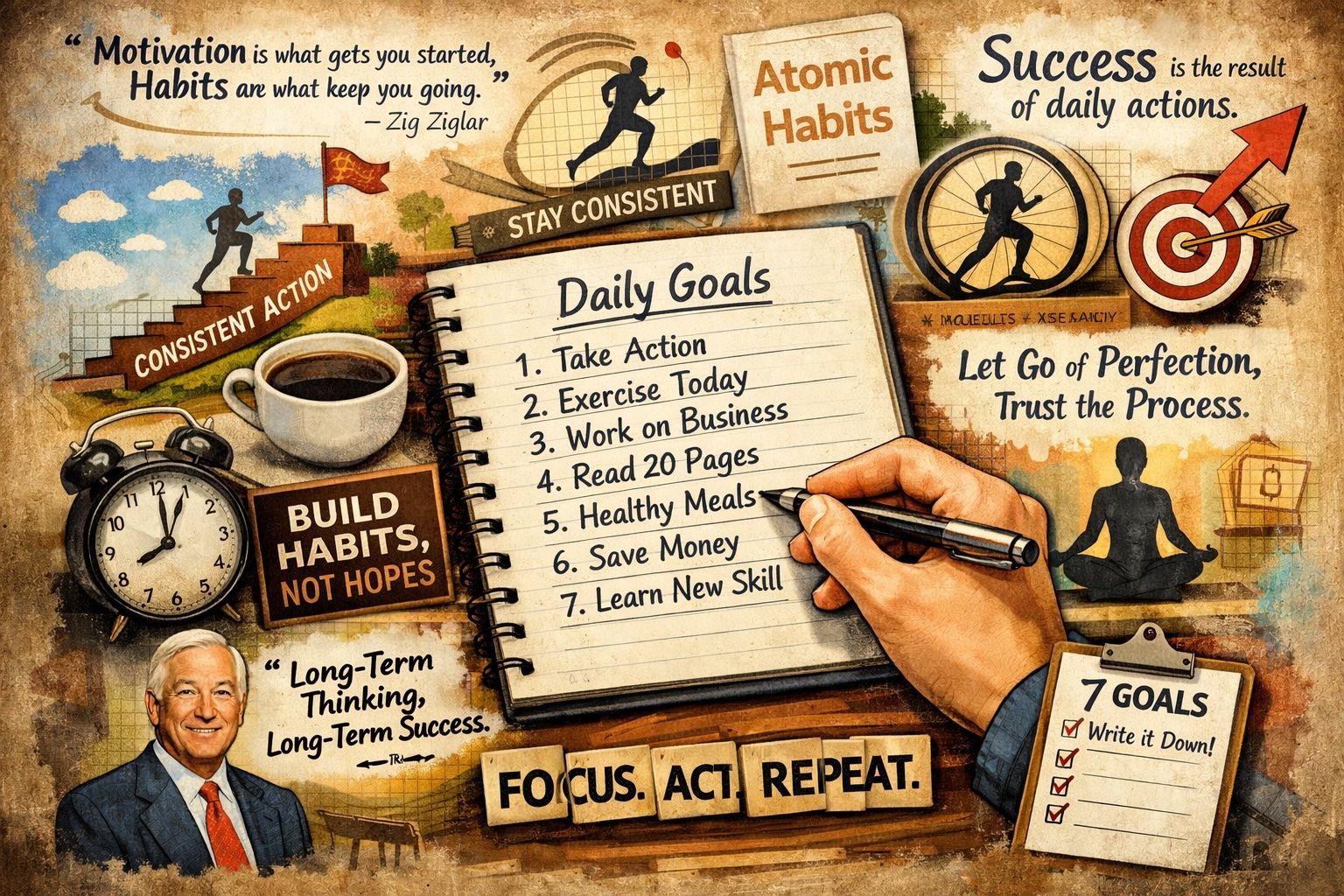
The Rule: You must WRITE (not read).

Reading affirmations is passive. It’s lazy. Writing them forces your brain to engage. Every single morning,

you need to put pen to paper and write just three things:

1. The Big Vision: Remind yourself where the ship is heading. If you don't know the destination, any

wind is the wrong wind.

2. Your focus affirmation: Exactly why and what you are doing it all for.

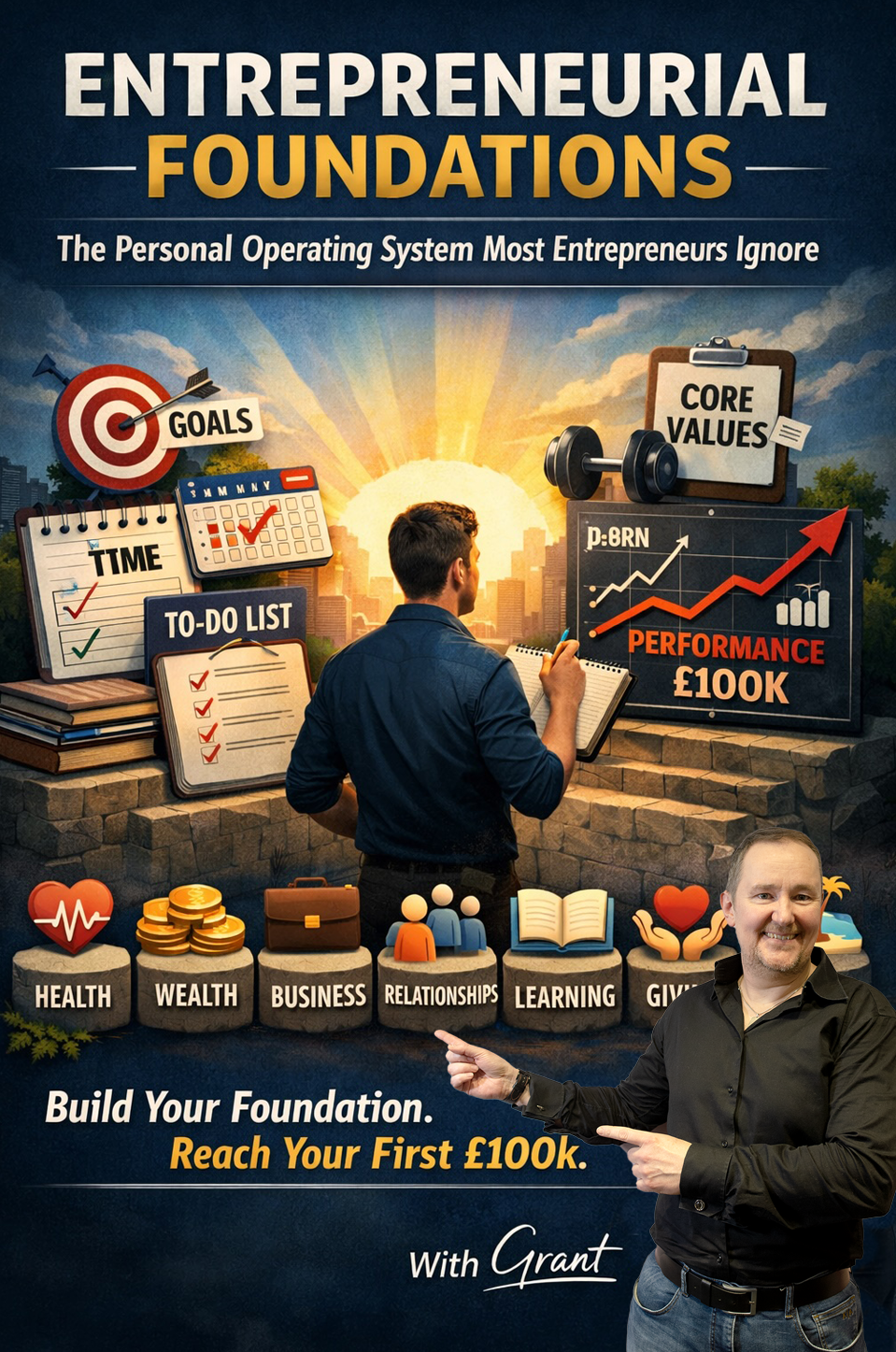
3. Your 7 goals: 7 measurable goals for health, money, business, relationships, learning, giving and

fun. For each one you write what you will do next to get closer to achieving that goal.


This isn’t "manifesting" fluff. This is neurological programming. You are literally telling your brain

what to focus on before the chaos of the day hits. If you can’t give yourself ten minutes, you don’t

own a business: your business owns you.


The 7-Goal-Setting Process: Total Life Alignment

Here is where most founders get it wrong. They set "Business Goals" and ignore everything else. Then

they wonder why they’re divorced, out of shape, and miserable despite having a healthy bank balance.


That’s not success. That’s a failure in a fancy suit.


I teach a 7-goal system because your business is only as strong as the human running it. You need a

foundation across seven specific pillars:

• Health: If you’re dead, the business stops. Simple as that.

• Wealth: Money is the fuel for your mission. Don't be afraid of it.

• Relationships: Business is lonely. If you lose your tribe on the way to the top, the view will suck.

• Learning: The moment you stop being a student, you start becoming a dinosaur.

• Business: The tactical, strategic growth of your company.

• Giving: What’s the point of winning if you aren't helping anyone else?

• Fun: If it’s all grind and no play, you’ll burn out before you reach the first milestone.


You need to set specific, measurable targets for each of these. Why? Because a founder who is physically

fit, mentally sharp, and emotionally supported will outperform a stressed-out "hustler" every single

day of the week.


The Execution Engine: From Vision to Habit

"Vision without execution is hallucination." Thomas Edison said that, and he was spot on.

The Dream Gap exists because people have 12-month dreams but 24-hour habits that don't match

them. You need a system that breaks the "big scary goal" down into something you can actually do

on a Tuesday morning at 10 AM.


The Breakdown Structure:

1. 12-Month Outcomes: What does "winning" look like a year from now?

2. Monthly Milestones: What needs to happen by the end of this month to stay on track?

3. Weekly Actions: What are the specific tasks for the next seven days?

4. Daily Habits: What are the non-negotiable repeats that keep the engine running?


The Breakdown Structure:

1. 12-Month Outcomes: What does "winning" look like a year from now?

2. Monthly Milestones: What needs to happen by the end of this month to stay on track?

3. Weekly Actions: What are the specific tasks for the next seven days?

4. Daily Habits: What are the non-negotiable repeats that keep the engine running?


It’s None of Your Business What Other People Think

One of the biggest obstacles in the Dream Gap is the fear of judgment. You start a business, and suddenly

everyone has an opinion. Your mates think you're "lucky," your family thinks you're "risky," and

the "naysayers" are just waiting for you to trip up.


Let them talk.


In fact, it’s actually rude to try and guess what people are thinking about you. It’s a waste of mental

energy that should be spent on your 7 goals. As I always say, it’s none of your business what other

people think. Your only job is to build the foundation and stay the course.


The Bottom Line: Foundation is Everything

You can have the best AI tools, the slickest marketing, and the most innovative product in the world.

But if your daily habits are shambolic and your goals are only focused on your bank account, you will

eventually hit a wall.


The Dream Gap is real, but it’s avoidable.


You bridge it by being more disciplined than your competition. You bridge it by writing those affirmations

every morning when you’d rather be sleeping. You bridge it by caring about your health and

your relationships as much as your KPIs.


It’s time to stop dreaming and start building. Are you actually ready to be an entrepreneur? I mean,

really ready? Because if you are, the first step is getting your system in order.


Your First Step

I’ve put together a visual guide to the 7-Goal-Setting Process. It’s the same system I’ve used to help

hundreds of founders find clarity and scale without losing their minds. It’s a simple poster you can

stick on your wall to remind you what actually matters every single day.


Download the free 7 Goals System poster here.


Don't just read this and move on to the next blog post. Print the poster. Write your affirmations tomorrow

morning. Build the foundation. The view from the top is much better when you know the

ground beneath you isn't going to give way.


To your success,


Grant
By Grant Stain March 22, 2026
Listen, if you’ve spent more than five minutes on social media lately, you’ve seen it. The doom-scrolling, the hand-wringing, and the absolute panic about Artificial Intelligence. The headlines are relentless. "AI will replace 40% of jobs by 2030." "The end of human creativity." "Will we all become obsolete?" It’s enough to make you want to throw your laptop in the Thames and move to a cabin in the woods. But here’s the thing: the naysayers are missing the most important part of the equation. They’re looking at the tech, but they’re completely ignoring the most powerful force on this planet. You. The human element is the ultimate wild card. We aren’t just passengers on this ride; we are the ones built the car, designed the engine, and are currently sitting firmly in the driving seat. If you’re feeling a bit of trepidation about what’s coming, let’s clear the air. It’s time to stop looking at AI as a threat and start seeing it for what it actually is: the greatest leverage tool in human history. The Myth of Human Obsolescence History is littered with the corpses of "expert" predictions that proved humans would be ruined by technology. When the printing press was invented, people feared it would destroy our memories and undermine the authority of the wise. Instead, it democratised knowledge and sparked the Renaissance. When the industrial revolution kicked off, the Luddites smashed the machines because they thought work was over. Instead, it created the middle class and a level of prosperity previously unimaginable. Every single time we innovate, the "sky is falling" crowd comes out in force. And every single time, they are wrong. Why? Because humans are natural-born innovators. We are survivors. We don’t just sit there and let change happen to us; we find ways to build, adapt, and thrive. We have an innate drive to create something from nothing. AI doesn't have that. It never will. AI doesn't wake up in the morning with a burning desire to disrupt an industry. It doesn't feel the "itch" to solve a problem that’s been bugging it all day. It doesn't have a "why." AI is totally unemotional to its own experience. It doesn't care if it wins. It doesn't care if it fails. It’s a tool, an incredibly sophisticated one, but a tool nonetheless. You are the one with the vision. You are the one with the soul. The Missing Piece: The Human Element The debates you see on the news are usually dry, academic, or purely mathematical. They talk about "output," "efficiency," and "automation." What they miss is the nuance of human connection, intuition, and the "gut feeling" that every successful entrepreneur relies on. Think about your business for a second. Is it just a series of tasks? Of course not. It’s a web of relationships, trust, and shared vision. AI can write a contract, but it can’t look a partner in the eye and know if they’re full of it. It can analyse market data, but it can’t feel the shift in cultural momentum before it shows up in the numbers. We are in the driving seat because we provide the direction. AI provides the speed. When you combine the raw processing power of AI with the creative spark of a human being, you don't get "disenfranchisement." You get a superpower. If you're still stuck in the mindset that you're competing against AI, you've already lost the game. The goal isn't to be a better calculator than the computer; the goal is to be the best possible human using the best possible tools. That’s how you achieve entrepreneurial empowerment . Welcome to the AI Nirvana Let’s talk about the "AI Nirvana" that the doomers don't want to mention. Everyone is so focused on what might be lost that they’re blind to what is being created. We are on the verge of a creative explosion. Imagine a world where the boring, soul-crushing admin that eats up 60% of your day simply vanishes. No more filing, no more basic data entry, no more scheduling nightmares. When that happens, what are you going to do with all that extra brainpower? You’re going to create. We are going to see entirely new industries born in the next five years that we can’t even name yet. Just as the internet created the "Social Media Manager" and the "Cloud Architect," AI is going to create roles that focus entirely on high-level strategy, human-centric design, and complex problem-solving. Problems that have plagued humanity for decades, diseases that were too complex to model, logistical nightmares that wasted half the world’s food, energy inefficiencies, are going to be solved. Not by AI alone, but by humans using AI to see patterns we couldn't see before. This isn't a dark future. It’s a bright one. It’s a world where human creativity is finally unshackled from the mundane. Protecting Against the Negatives (The Adult Way) Now, I’m not saying there won't be challenges. Every major shift has friction. Yes, some roles will change. Yes, some traditional jobs will fade away. But rather than cowering in fear, we need to be proactive. Iterate or Die: You need to be looking at your business right now and asking: "Where can I use this to move faster?" If you're not doing it, your competitor is. Check out my 73-point marketing audit to see where you can tighten your systems. Double Down on "Human" Skills: Empathy, communication, leadership, and ethical judgment are now the most valuable assets you own. You can't outsource your soul. Stay in the Driver's Seat: Don't let the tech dictate your direction. Use it to execute your vision. If you're worried about being "replaced," it's usually because you’ve stopped innovating. You’ve become a cog in a machine. The solution isn't to stop the machine; it's to stop being a cog. Take a strengths test and find out what makes you uniquely capable of leading in this new era. The Choice is Yours At the end of the day, you have two choices. You can join the chorus of naysayers, complaining about how "it was better in the old days" while the world passes you by. You can let fear dictate your business strategy and end up as a footnote in history. Or, you can embrace the fact that you are an innovator. You can realise that AI is the most incredible gift for someone with a vision. It’s the ultimate force multiplier for the entrepreneur who refuses to be disenfranchised. I’ve coached hundreds of founders, and the ones who win are always the ones who see opportunity where others see obstacles. They don't ask "Will this replace me?" They ask "How can this make me ten times more effective?" Sound familiar? It should. Because that’s the entrepreneurial spirit. It’s messy, it’s fast, and it’s unstoppable. Stop listening to the people who are afraid of the future. They aren't the ones building it. The AI revolution isn't about the machines. It’s about what we do with them. We are the creators. We are the innovators. And we are just getting started. If you’re ready to stop being a victim of the headlines and start taking control of your business’s future, let’s talk. Whether it’s through entrepreneur coaching or just getting your foundations right, the time to move is now. The "AI Nirvana" is waiting. Are you coming? To your success, Grant
By Grant Stain March 1, 2026
Let’s be honest: most people in my position would tell you that they want to help everyone. They’d post some fluffy quote about "unlimited potential" and invite you to "jump on a discovery call" so they can sell you a dream wrapped in a 12-month contract. I don’t do that. In fact, I turn down about 80% of the founders who reach out to me for coaching. Does that make me a bit of an arse? Maybe. Does it make me elitist? I hope not. The intention is to ensure I'm effective. I’ve spent over 20 years in the trenches. I’ve personally founded 24 businesses in five different countries. If there’s one thing I’ve realised, it’s that most founders aren't looking for a coach, they’re looking for a miracle. And I don’t sell miracles. I sell systems, accountability, and the hard-won perspective that comes from two decades of seeing what actually works. If you’re wondering why I might say "no" to you, or more importantly, how you can become the kind of founder I say "yes" to: read on. The "Spark" vs. The "Curiosity" Most founders come to me because they are "curious" about coaching. They’ve heard it’s what successful people do. They think a weekly Zoom call will magically fix their cash flow or settle their internal team dramas. Curiosity is cheap. Commitment is expensive. When I talk to a founder, I’m looking for a specific "spark." It’s not about how much money they’re making right now; it’s about their hunger for freedom and their willingness to set their ego on fire to get it. I work with people who are obsessed with making their own choices. People who realise that being a "boss" is meaningless if you’re still a slave to your inbox and your overheads. If you don't have that fire, no amount of coaching is going to ignite it for you. The Magic Pill Delusion Here is a reality check: Coaching is not a magic pill. If your business is a flaming inferno of half built bridges because you refuse to look at your numbers, a coach isn't a fire extinguisher. If you’re lazy, a coach isn't a shot of adrenaline. I’ve seen founders treat coaching like a confessional. They show up, admit their "sins" (I didn't do the work, I didn't hit the targets, I got distracted by a new shiny object), and expect me to absolve them so they can feel better. Not on my watch. My coaching is for the founders who understand that I am the Obi One, but they are the Luke Skywalker. I provide the experience, I point out the pitfalls, and I show you the shortcuts I’ve found over 20 years from either falling through them myself or narrowly avoided thanks to my coach at the time (or Yoda, lol - love a Star Wars metaphor!). If you’re looking for someone to do the work for you, you aren't actually ready to be an entrepreneur. 20 Years, 300+ Startups, 12 Countries Why am I so picky? Because my reputation is built on real experience, not just coaching qualifications. I’ve seen the 7 fatal mistakes solo founders make played out in real-time, over and over again. I turn people down because coaching is about the right fit and feeling very confident that my mentee is someone I know I can help: either because they are ready to listen or because they have built a foundation worth scaling yet. The Foundation: Are You "System-Ready"? Being "ready" for high-level coaching means you have a foundation. You can’t build a skyscraper on a swamp. Before I even consider working with someone deeply, I want to know about their systems. Not just their CRM or their marketing tech stack, but their personal operating system. 1. The Morning Routine Winning the day starts with managing mindset first and foremost. My clients know that discipline is the prerequisite for freedom. If you can't manage your first two hours of the day, how on earth are you going to manage a scaling organisation? 2. The 7-Goal-Setting Process I’m a fanatic about goal setting. But not the vague "I want to be rich" nonsense. I use a specific 7-goal-setting process that covers every area of life: Business, Finance, Health, Relationships, Learning, Giving, and fun. If you don't have a target, you’ll hit nothing every single time. My coaching is about alignment. If your business is thriving but your health is in the bin and your relationships are failing, you aren't successful: you’re just a high-earning wreck. Why I Choose the 20% The 20% I do work with? They are the good fit, coachable maniacs who get that being an entrepreneur is a lifestyle in itself not the vehicle to the lifestyle. They are the ones who realise that the ultimate currency isn't GBP or USD: it’s choice . They want to work towards the privilege of building a legacy whilst still having the time to be with their families, whilst creating something that actually outlasts them. They understand core values aren't just something you print on a poster; they are the DNA of the company. When I find a founder who has that spark, who is disciplined, and who is ready to be challenged, we do incredible things. We don't just "grow" the business; we transform it. How to Know If You’re Ready So, are you part of the 80% or the 20%? Ask yourself these questions: Am I looking for a mentor or a babysitter? (If you need someone to remind you to do your basic tasks, you need a virtual assistant, not a coach.) Am I willing to be told I’m wrong? (If your ego is too fragile to hear that your "brilliant" idea is actually a bottleneck, don't call me.) Do I have a baseline of discipline? (Have you mastered your morning? Have you tried to implement a system like the 7-goals-poster ?) Is my business "coachable"? (Do you have a product or service that actually provides value, or are you just "grinding" for the sake of it?) If you can answer those honestly and still feel like you’re ready to level up, then maybe we should talk. Don't Guess. Test. I don’t expect you to take my word for it. Most founders think they are ready, but they haven't actually looked at the data. Before you even think about applying for entrepreneur coaching , take the strengths test . See where you actually stand. I’m not interested in working with the version of yourself you project on LinkedIn. I’m interested in the version of you that shows up when things are falling apart and the pressure is on. The Bottom Line I turn down 80% of requests because I value my time, and I value yours. There is no point in me taking your money if you aren't in a position to execute the strategies I give you. It’s bad for my brand, and it’s a waste of your capital. But for the 20% who are ready... for the founders who have the foundation, the spark, and the absolute refusal to settle for a "normal" life... the results are nothing short of life changing (you see why I love my job!). Success isn't about working harder; it's about working with the right people, with the right systems, at the right time. Stop being "curious" and start being committed. If you think you're ready to be one of the few, get in touch . But don't be surprised if I tell you you’re not there yet. I’d rather tell you the truth today than watch you fail tomorrow.  To your success, Grant
By Grant Stain February 22, 2026
Let me guess: you've been scrolling through Instagram, watching people your age sipping cocktails on a beach at 2PM on a Tuesday, captioning it "living the laptop lifestyle" or "escaped the 9-5 grind." You've seen the Lamborghinis, the "passive income," the overnight success stories. And you're thinking, "Yeah, I could do that. I'll work hard, hustle a bit, post some motivational quotes, and boom, financial freedom." Right? Wrong . Listen, I've coached over 300 startups through their early days, and I need to tell you something that the Instagram gurus won't: most people who start businesses fail. And I don't mean they fail spectacularly in some heroic blaze of glory. I mean they quietly earn less than they did in their job, work twice the hours, and eventually slink back to employment with their tail between their legs. Sound harsh? Good. Because if that scares you off, you've just saved yourself years of pain and a hefty chunk of money. The Numbers Don't Lie (Even When We Want Them To) Let's talk facts, because I'm not here to blow sunshine up your backside. " Only 4% of startups ever hit £1 million in turnover." Four percent. That's 96 out of every 100 businesses never getting anywhere near that magical seven-figure mark that sounds so good on a podcast. And for those lucky few who do? It takes an average of 2.5 to 3 years minimum. Many don't see it within 5 years. That's three years of grinding, pivoting, barely paying yourself, and wondering if you've made a massive mistake. Here's the kicker: " 41% of small business owners earn less than they did in their previous 9-5 job ." Less. After all that risk, all that stress, all those 60-hour weeks, they'd have been better off financially staying put. Over 20% of businesses fail within their first year. Nearly half don't make it to year five. And of those solo entrepreneurs dreaming of building a team and "scaling"? Only 3-17% ever grow to hire employees and become actual employer firms. These aren't stats I'm pulling from some doom-and-gloom think piece. This is reality. This is what happens when passion meets market forces, when optimism crashes into cash flow problems, when "I have a great idea" meets "the customer doesn't actually care." So Why Am I Telling You This? Am I trying to put you off? Kill your dreams before they start? Absolutely not. I'm trying to save you from being another statistic. Another person who quit their job on a wing and a prayer, burned through their savings in 18 months, and had to explain to their family why they're moving back in at 34. The issue isn't that entrepreneurship is hard, we all know it's hard. The issue is that most people think they're ready when they're absolutely not. They confuse excitement with preparation. They mistake motivation for capability. After working with hundreds of founders, I can tell you this: " Entrepreneurship isn't about the destination, it's about whether you've got the foundations to survive the journey." The lifestyle you see on social media? That's year 7, not year 1. And most people never make it past year 2. The Unsexy Truth About What It Actually Takes Here's what nobody posts on Instagram: You're going to work more hours than you ever did in your job. Your first year? Think 50-60 hours a week, minimum. Weekends included. No, you can't outsource everything on day one, you haven't got the money. You're going to earn less. Probably for at least the first year, maybe longer. Can you handle that? Can your family? Your mortgage lender? You're going to question yourself constantly. Every day you'll wonder if you're deluded. Every setback will feel personal because it is personal, this is your baby. You need to actually know how to run a business. Not just do the thing you're good at, marketing, design, whatever, but understand P&Ls, cash flow, break-even points, customer acquisition costs. When's the last time you read a balance sheet? Do you know what gross margin means? These aren't optional extras. They're the difference between profit and bankruptcy. You need support systems. Mentors who've been there. A partner who understands why you're stressed. Friends who won't roll their eyes when you cancel drinks for the third week running. Family who won't tell you to "just get a real job" the first time things get tough. Before You Quit Your Job, Answer These I've developed a framework over the years for assessing readiness. Not readiness to have an idea, everyone's got ideas. Readiness to actually build a business that doesn't destroy your life. Can you honestly answer yes to these? - Have you done the research and actually understand the market? - Do you have 6-12 months of living expenses saved (not just "some savings")? - Have you created a proper business plan with realistic financial projections? - Do you know your break-even point and startup costs down to the pound? - Can you identify your exact target customer and why they'll buy from you instead of your competitors? - Are you prepared to potentially earn less for the next 2-3 years? - Does your family support this decision, or are you going to be fighting battles on two fronts? If you're hedging on more than two of these, you're not ready. And that's okay, better to know now than after you've burned your bridges. It's About the Foundations, Not the Flash Look, I'm not trying to crush your entrepreneurial spirit. I've built businesses. I've helped 300+ companies get off the ground. I believe in entrepreneurship, done right. But "done right" means building proper foundations before you start stacking up floors. It means developing the skills, knowledge, and mindset that separate the 4% from the 96%. The entrepreneurs who make it aren't necessarily the most talented or the ones with the best ideas. They're the ones who prepared properly. Who learned the fundamentals. Who built systems instead of winging it. Who understood that success is about doing boring things consistently, not having one viral moment. They're the ones who treated entrepreneurship as a serious professional decision, not an escape plan from a job they didn't like. The Real Question So here's what I want you to ask yourself: are you running toward something, or running away from something? If you hate your job and think starting a business will be easier, I've got bad news. It won't. It'll be harder in ways you can't imagine. But if you're genuinely prepared to work harder than you've ever worked, to learn things that don't come naturally, to sacrifice lifestyle in the short term for a potential long-term payoff, and you've got the foundations in place, the knowledge, the savings, the support, the actual plan, then maybe, just maybe, you're ready. And if you're not ready yet? That's brilliant. Because now you know what you need to work on before you take the leap. The wannabe entrepreneurs quit their jobs tomorrow and hope for the best. The real entrepreneurs build their foundations first , develop their skills, understand the reality of what they're getting into, and then make their move from a position of strength, not desperation. Which one are you going to be? To your success, Grant
By Grant Stain February 8, 2026
This is a subtitle for your new post
By Grant Stain January 25, 2026
(And Why It's Actually Rude to Try and Guess)
By Grant Stain January 18, 2026
Are You Making These 5 Fatal Startup Mistakes? What 15 Years Coaching 300+ Companies Taught Me
By Grant Stain January 11, 2026
The Personal Operating System Most Entrepreneurs Ignore
By Grant Stain January 4, 2026
Every January, people don’t fail because they lack motivation...
Clipboard with
By Grant Stain December 28, 2025
Why Most People Get It Wrong, and How to Fix It
By Grant Stain December 15, 2025
Breaking Down the Real Numbers and Hard Truths