The 3-Hour Morning Routine That Built 25 Businesses: My Exact First 180 Minutes (Free Checklist Inside)
If you are a founder, does this morning routine sound familiar to you?
Wake up, reach for the phone, scan a few messages, check the news, answer something “urgent,” and then your mind belongs to everybody else.
Ring any bells?
This is not an optimal founder daily routine. This is a fast-track system for becoming an employee of your inbox.
I have built and operated 25 businesses across sectors including design, branding, marketing, recruitment, property, digital services, apps, leisure and more. I have also coached more than 300 startups across 12 countries over 15 years.
The pattern is clear: your business cannot become more disciplined than you are.
That is why I protect the first 180 minutes of my day. Not because waking early makes you virtuous. Not because you need to copy somebody’s ridiculous 4:30 am routine (although that may suit your clock better than mine!).
You need a repeatable system that gives you energy, direction and meaningful progress before the noise starts. The idea here is to make your morning routine your own based on these principles. You don't need to copy me exactly but you must commit to a routine that sets you up for the day.
Here is my exact morning routine for entrepreneurs.
⸻
The rule: your first three hours belong to you
Before we get into the timetable, understand the principle.
Your first three hours are not for:
- Slack
- Social media
- News
- Other people’s emergencies
- Random admin
- “Just quickly checking” anything
The world will happily fill your morning with low-value demands. Let it wait.
Research and founder routine analysis consistently point towards the same conclusion: protect your early hours, use visualisation and movement to activate your body, clarify your priorities, then complete one important piece of deep work before entering reactive mode. Calendar’s founder morning routine guide reaches the same practical conclusion: sustainability beats performance theatre.
You do not need a perfect morning.
You need a protected one.
⸻
Minutes 0–10: Wake, visualise and hydrate
The first ten minutes are deliberately boring.
That is the point.
When I wake up, I do not touch my phone. I lie in bed and visualise my day and ideal life in a positive state of mind. This half-awake, half-asleep state is thought to be the most powerful state to impress upon your unconscious mind. I then get out of bed and begin my water, vitamins and freshly ground coffee routine.
Your body needs a clear signal that the day has started, a solid routine once you are out of bed will do the trick.
Do this:
- Get out of bed when the alarm goes off.
- Visualise your day whilst still in bed.
- Think positively about the meetings you have planned with awesome outcomes
- Imagine yourself completing your tasks in the best way possible
- Imagine yourself living your best life and how that will feel when achieved
Enjoy this routine and feel the emotions of the results you are going to achieve that day before you actually start actioning them all.
Most important: Your first decision of the day should be yours: not your phone’s.
⸻
Minutes 10–35: Reviewing your seven goals
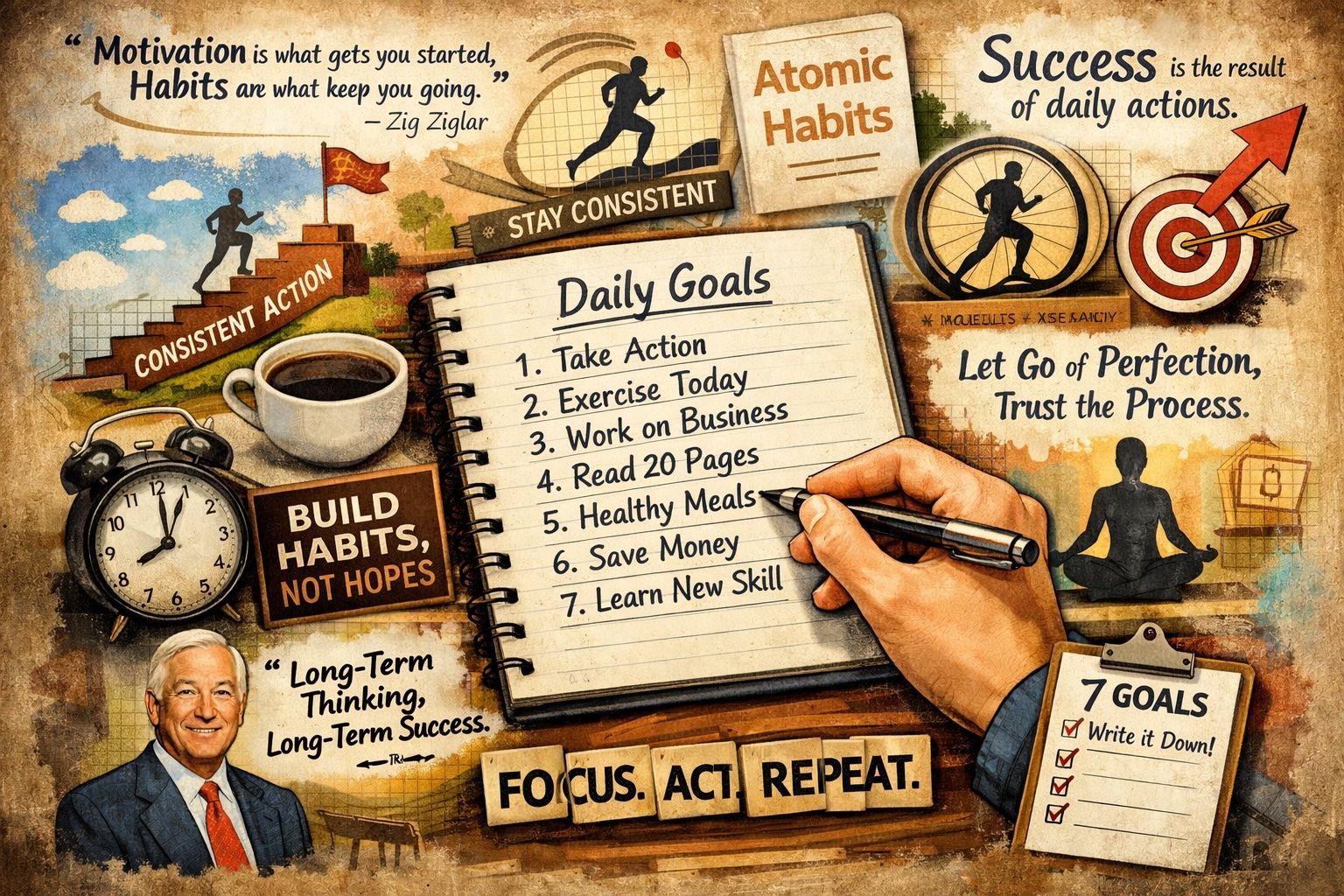
I always set myself up to write donw my goals witha feel good factor already prepped. For me that means making freshly ground coffee with a splash of cream whilst listening to my feel good play list in my kitchen. I then sit in my favourite chair and open my specially chosen notebook and begin my 7-step goal-setting method.
I start by writing down my vision for my life and business on one side of the pad and then write down my annual goals.
Your business is not separate from your life. If your health collapses, your business suffers. If your relationships deteriorate, your freedom becomes meaningless. If you stop learning, your strategy gets stale.
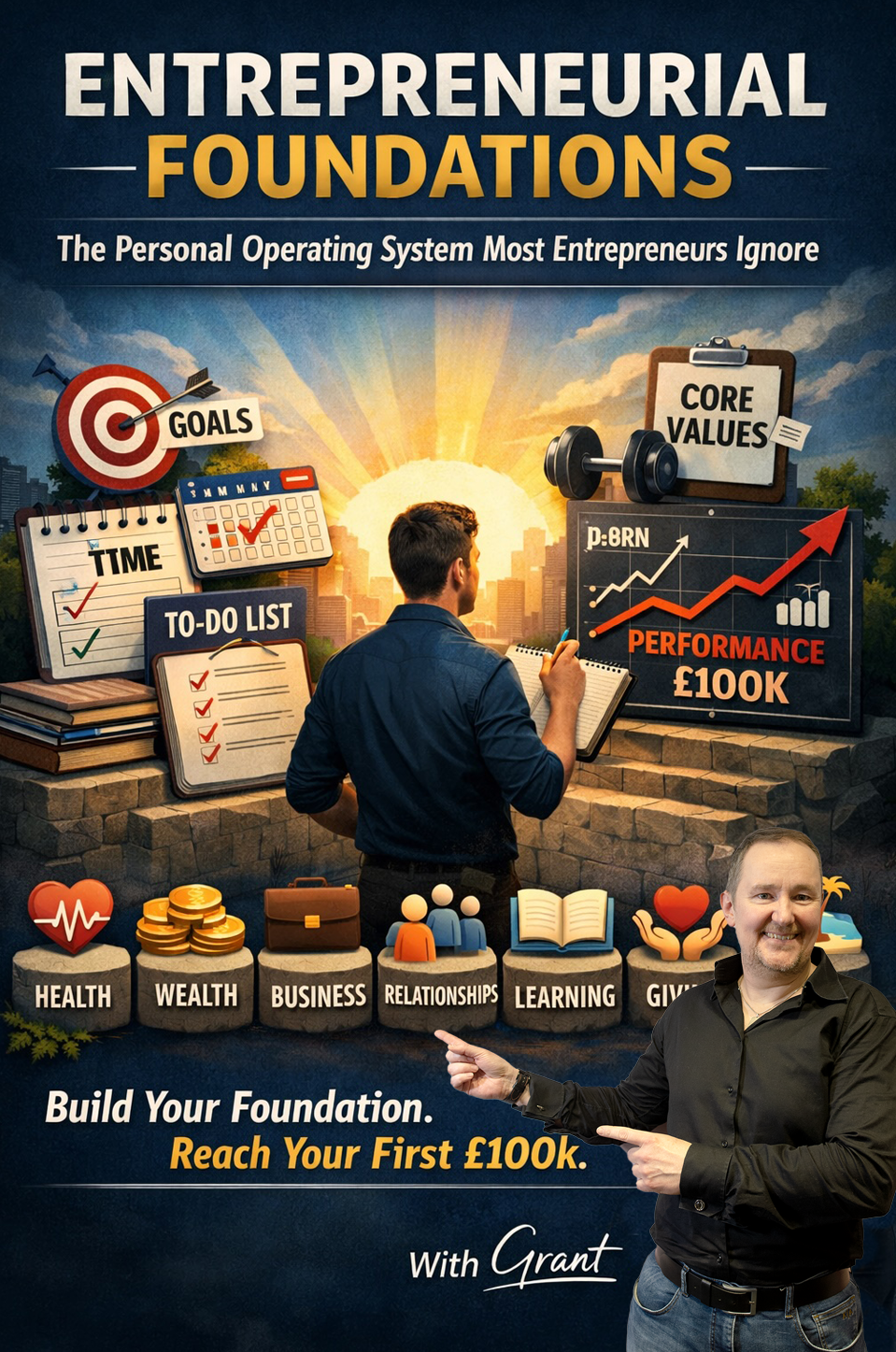
My seven goal areas are:
- Health
- Finance
- Business
- Giving
- Relationships
- Learning
- Fun
You do not need to work on all seven every morning. That would be another form of overcomplication.
Instead, review your overall goals and ask:
> “Which one action today will move one of these areas forward?”
For example:
- Health: Complete your workout or plan your food diary.
- Finance: Review cash flow or follow up a valuable opportunity.
- Business: Improve your offer, sales process or customer experience.
- Giving: Support a team member, client or charitable cause.
- Relationships: Have an uninterrupted conversation with someone important.
- Learning: Read, practise or study something directly relevant to your future.
- Fun: Protect time for an experience that makes the journey worthwhile.
Give this block a proper 25 minutes. Ten minutes to reconnect with the bigger vision. Ten minutes to review the seven areas. Five minutes to identify where today’s leverage actually sits.
Your daily actions should serve your long-term vision.
Otherwise, you are just being busy with better branding.
⸻
Minutes 35–50: Choose your one mission-critical action towards a goal
Now choose your MIT: your Most Important Task.
Not five tasks. One.
Your MIT must be connected to a meaningful outcome and will nearly always be in accordance with one of your goals. It should require your best thinking and create progress that cannot be delegated easily.
Examples include:
- Researching a new product
- Defining your positioning
- Preparing a funding proposal
- Booking an appointment
- Creating a recruitment plan
- Analysing your margins
- Building a strategic partnership
- Solving the operational bottleneck slowing your growth
- Contacting one of your highest-value prospects
Do not choose “check emails”.
Email is communication. It is not automatic progress.
Write your MIT in a way that defines completion:
- Weak: “Work on marketing.”
- Strong: “Write the first draft of the homepage messaging.”
- Weak: “Think about sales.”
- Strong: “Create the three-stage sales follow-up sequence.”
- Weak: “Improve operations.”
- Strong: “Document the client onboarding process and identify two steps to delegate.”
Spend the extra few minutes pressure-testing the task. Is it specific? Is it measurable? Will it actually move the needle? If not, tighten it up before the day starts dragging you off course.
Clarity creates momentum.
If the task is vague, your brain will avoid it. If the task is specific, you can begin.
⸻
Minutes 50–110: Move your body
Everyone's routine will vary and you do not need to complete an Olympic training session before breakfast (but great if that's your thing).
You do need to move.
For me, exercise has always been part of the wider discipline required to run businesses. Movement raises your energy, clears mental fog and reminds you that action comes before motivation.
This is where your routine may change depending on the length of time you spend exercising on that morning.
Choose one depending on your exercise routine for the day:
- A brisk 15-minute walk
- Mobility and stretching
- Bodyweight exercises
- A gym session up to 1hr
- Cycling
- Light jogging
- A simple combination of squats, press-ups and planks
I work out in the gym four or five times a week so two or three of those heavy sessions are on weekdays. My routine accommodates this, so the days I don't train in the morning, I walk or stretch.
Move first.
⸻
Minutes 110–130: Shower and breakfast
This is the transition between personal time and founder time, and the timing depends on how long you spent moving.
Have your shower. Get dressed. Make your breakfast (I sometimes make breakfast before exercise if I'm doing a big weights session).
The important point is that you do not drift into the working day. You move into it intentionally.
Your environment matters here. Prepare the night before:
- Put your gym clothes or walking shoes where you can see them.
- Set up your workspace.
- Leave your notebook and pen ready.
- Decide what your first deep-work task will be.
- Keep unnecessary notifications switched off.
A strong morning routine for entrepreneurs starts the night before. You remove friction so that the right action becomes the easiest action.
Do not rely on willpower when preparation will do the job.
⸻
Minutes 130–170: Complete 40 minutes of deep work
This is the engine room.
For 40 minutes, you work on one task only.
No inbox. No calls. No tabs that are not directly connected to the task. No checking your phone “just in case”.
Set a timer. Close everything else. Tell your team you are unavailable if necessary.
During this block:
- Work from a written outcome.
- Keep a notepad nearby for distracting thoughts.
- Capture interruptions rather than following them.
- Do not polish endlessly before creating a complete first version.
- Stop switching tasks when the work becomes difficult.
The hard bit is often the valuable bit.
This is where founders separate themselves from spectators. Everybody wants freedom, but very few people are willing to spend 40 uninterrupted minutes building the foundations that create it.
You do not need more content about productivity.
You need fewer distractions and more finished work.
An example of this is I am writing this blog right now in the deep work session.
⸻
Minutes 170–180: Review, calendar, start the day
The final 10 minutes are for transition.
Do not leap straight from deep work into chaos. Record what you completed and decide what happens next.
Use this simple close-down:
- Review the results of your deep-work block.
- Note the next action if the task is unfinished.
- Check your calendar and update where necessary.
- Triage messages into:
- Action
- Delegate
- Schedule
- Archive
- Respond only to genuinely urgent items.
Now you can open email and messages because you have already created value.
That is the difference between proactive and reactive work. You are not entering the day empty-handed, waiting for somebody else to decide what matters.
You have already moved the business forward.
⸻
The free 180-minute founder checklist
Save this checklist and use it tomorrow:
- 0–10: Visualise, get up, no phone
- 10–35: Routine, goals, write, feel the success
- 35–50: Choose one mission-critical action
- 50–110: Exercise
- 110–130: Shower, breakfast
- 130–170: Deep work
- 170–180: Record progress, review the calendar and triage messages
Print it. Put it beside your desk. Follow it for 14 days before changing anything.
If three hours is impossible because of children, shifts, travel or a demanding schedule, keep the order and compress the timings. A 10-minute version still works:
- Two minutes reviewing your MIT
- Three minutes moving
- Five minutes starting the most important task
The system must work on your worst day, not only when life is behaving itself.
⸻
Stop copying routines that do not fit your life
You do not need to wake at 5 am to become successful.
You need to be consistent.
Some founders are naturally sharp early. Others do their best thinking later in the day. The clock time is not the strategy. The protection, clarity and execution are the strategy.
Do not copy a routine because it looks impressive online. Build one that supports your responsibilities, energy and ambitions.
The best founder daily routine is one you can repeat when:
- You slept badly
- A customer is unhappy
- Your child is ill
- Cash flow is tight
- The team needs support
- The previous day went completely off the rails
That is when your systems earn their keep.
Your morning is not about becoming a productivity robot. It is about becoming the kind of leader who chooses the agenda before the world chooses it for you.
If you want the complete framework behind this approach, download the free 7 Goals System Poster. Use it to clarify where you are going, identify the next step and make your progress visible.
And if you are serious about building a business on solid foundations, learn more about my entrepreneurial coaching.
You do not need another year of scattered effort.
You need a clear goal, a protected morning and the discipline to do the work.
To your success,
Grant